Showing posts with label Food. Show all posts

Thursday, August 26, 2010

Dinner Rush


One of the most frequent letters received here at The Blushing Hostess asks how to introduce new dishes to the family table; Carving out the time to research them, gather the ingredients, and so on.

Be forewarned: I'm not promising a twenty-minute dinner preparation, as I have never been party to one: I don't use processed foods in my kitchen and I don't consume things that come from boxes. Admittedly, then, this is speedy food for cooking fresh but not, say, anything as quick as (oh Lordy, help these souls) TV dinners or hot pockets.

I keep tabs on a tool over at the internet arm of Bon Appetit and (the former) Gourmet magazine called Dinner Rush (Quick and Easy Menus). A new menu of fresh, seasonally available dishes is posted each week with instructions and the week's work of grocery needs condensed into one small list. Both the menus and list are available on iPhone to save some paper as well.

I use it haphazardly at best. Most of the food decisions here three seasons a year are based on what is coming out of the garden on that day. It is most useful to me in these seasons for the protein suggestions, but once in a while the suggestions hit the crop availability at the same time.

For me, it is an indispensable tool now and hopefully, one more resource for your arsenal. Use it in good health.

Sunday, August 15, 2010

Thing of beauty: Creative catering presentations


I spotted this at an event this week: Tiny - miraculously, still crunchy - rice paper cones with a gorgeous - and thankfully still cold - tuna tartare hors d'oeuvre topped with wasabi caviar and presented in a bowl heaped with white and black sesame seeds. Like a sand beach for the tartare cones it was both a nod to the sea and a brilliant touch of flavor on the outside of the cone. Both delicious and a perfectly conceived passed nibble.

Tuesday, May 18, 2010

A short but perfect season


In the far west of France, the region of Alsace has long been a source of geopolitical strife between France and Germany. While I would love recap a millennium of agony regarding what belongs to whom, which religion, whose language, and how it was ruled, it is far beyond the scope of this page.

Aside from the storybook beauty of Alsace, a culture vibrant with centuries of gifts bestowed from east, west, and south of itself, it makes remarkable wines both dry and sweet (Gerurztraminer, Muscat, Pinot Blanc, Pinto Gris, Reisling, Cremant d'Alsace, and Pinot Noir) and has a commitment to asparagus worth a trip in spring.


Restaurants spring up between April and June and the only item on the menu is asparagus, generally served with three sauces: Hollandaise, mayonnaise, and vinaigrette.


Alsatian's will drink only one wine along side their prized asparagus; well-chilled dry muscat. Whether or not you go in person, or recreate this beautiful meal at home, I suggest you follow suit; locals know their pairings.

Asparagus is imported for fine purveyors and restaurants only during the legitimate season from the west of France. Check the tags at the grocery store: Although Mexico and other locales produce white asparagus (achieved by growing in darkened boxes, rather than in the mounded nutrient-rich soil of western France), they are generally an inferior product and it is worth, even if it is a splurge to experience this meal, to get the truly tasty asparagus of France. The season is only from late April until June 22 each year, so be quick.

For more on the history of Alsace and the French and German populations therein, read here.

Tuesday, May 11, 2010

The kitchen buffet


Honestly, what difference does it make if you serve the food family style, from a side board, or hanging from a circus high wire in a tutu while ladling gazpacho into shot glasses?

Etiquette texts of the old and dusty school will say absolutely not; get a staff! Alright, in the real world however, the staff often fails to report for duty (I sometimes wonder if they were only pithy imaginary British gents, anyway) and the food has to get from vessel to lips with one hostess and a house full of guests who seem, at least outwardly, capable enough to have read and responded to an invite, and followed directions to the house; therefore being presumably competent to amass food on a flat surface and get it to their mouth without insurmountable obstacle, all the while chatting on about that messy business in Bedford Garden Club (or, er, what have you).

I dare say, it is fine to put the food up on the counters in the kitchen, next to the plates, silverware, and napkins, and allow the diners or guests to fend for themselves in food-serving. There are times, as in the case of the this supper, with food that needs to be assembled to an individuals preferences (menus involving tortilla's and anything, for example), when the food is perfectly graciously - and more effectively - served in a spotless kitchen.

As a rule, the further the plates will move, the smaller they get (to be lap-friendly) and less precious (fewer tears shed over broken pieces). The same goes for the utensils: No sterling sees light when guests may be returning their own plates to the kitchen; to prevent it ending up in the trash by expensive accident. The napkins remain pressed cloth: Not only because paper is so flimsy, but it is eco-conscious.

Put the food out on the counters. Tell them I said so.

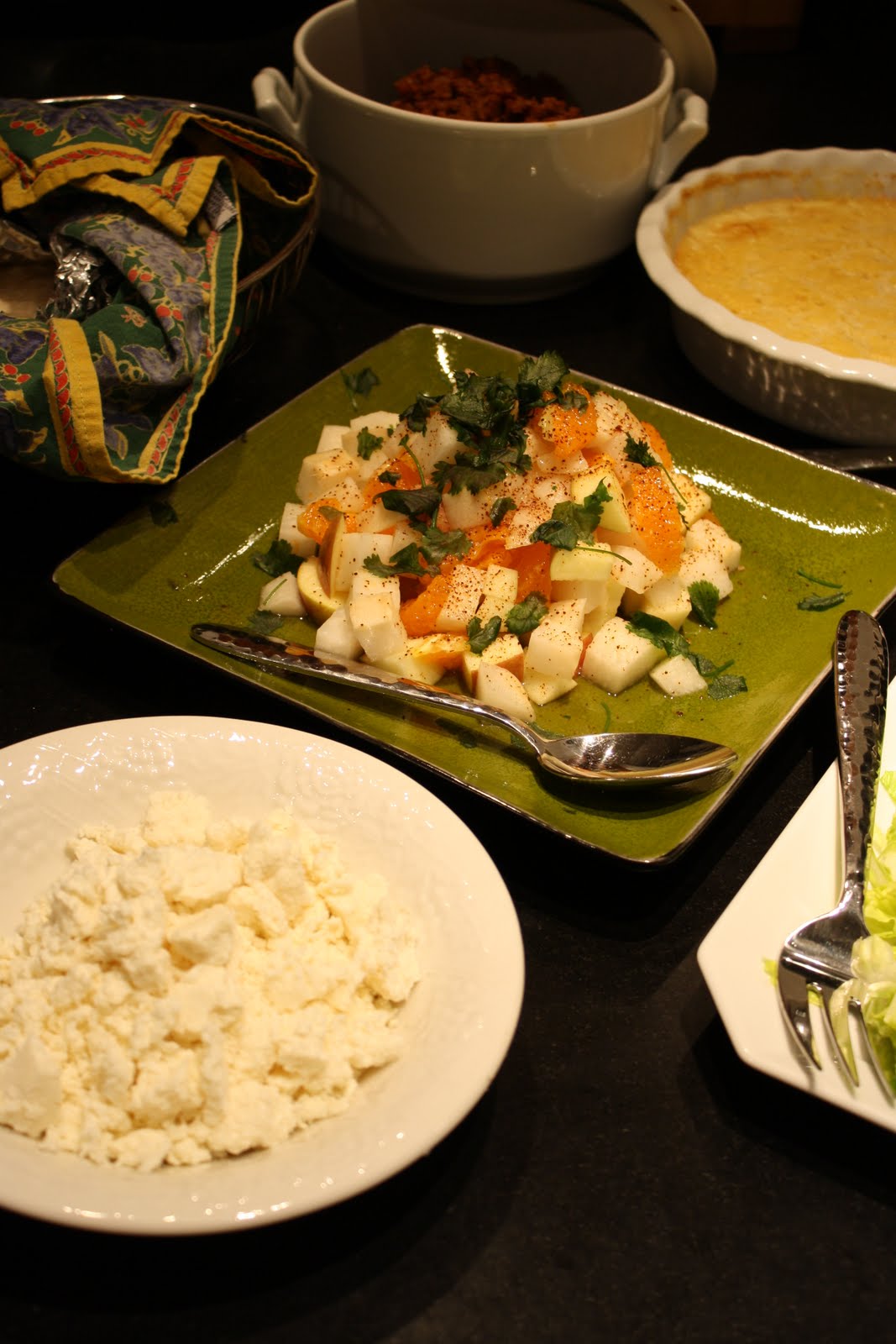
Saturday Night Supper Buffet

Carne Oaxaqueno Tacos with Queso Fresco

Friday, April 23, 2010

Fear of commitment

Spring has come in like a cool lion in the Piedmont; A lion resting tentatively in the yard, sometimes rolling in sunshine, sometimes growling with cold days and rain tantrums. Winter in the shade, summer in the sun, as they say.

I receive text messages on sunny days from friends at the nursery, "I want to buy tomato plants!" Carve some time out of your schedule to grieve for them and replace them, because it isn't time yet. Everyone is ready; everyone, it seems, but the lion in the yard.

But there have been clear signs of a impending spring, however non-committal. Mysterious asparagus have been springing up daily from an ancient garden plot (another gift from my ghost in the gardens). I fell asleep with the baby in the meadow behind the house then woke up only to realize someone was going to have to swath it, (ah-hem, the royal "someone"). And then I was writing to you about Fearrington House (and even as I write to you now, the onions, shallots, and leeks are caramelizing for Mrs. Fitch's savory tart) so, I've been taken with green things, it seems.

Nosing around the back field, I was reminded of the old iron table I found back there. It was left to its own devices seems like years ago. I need to replace the glass top somehow. Tell me where to begin?


Because now I have this beautiful dish ready.


And a table outside would be beautiful with these linens.


Somewhere in the fridge is a bottle of a delicious lemony crisp Sancerre.


I'm ready for the rain to stop and dinner in the yard, I wish the lion were not so afraid of commitment.

Onion, Leek, and Shallot Tart
adapted from the Fearrington House Cookbook, Jenny Fitch (1987, Dell)
serves 8

1 pie crust, partially blind baked in a tart or shallow pie pan
1 teaspoon Dijon mustard
1 pound leeks, thinly sliced, soaked in water to remove sand, dried
3 ounces butter
2 tablespoons olive oil
4 shallots, thinly sliced
1 sweet onion, thinly sliced
1/2 teaspoon salt
freshly ground pepper (black or white)
4 ounces bacon
2 eggs
3/4 cup heavy cream
freshly grated nutmeg to taste
1/2 teaspoon salt
freshly ground pepper (black or white)
1/2 cup Parmesan cheese
1 ounce goat cheese, crumbled
optional: 1 tablespoon fresh herbs
optional: 2 teaspoons butter

Preheat the oven to 375 degrees, brush the partially-baked pie shell with Dijon mustard and set aside.

Melt the butter in a heavy skillet and add the olive oil. Cook the leeks, onions, and shallots over medium-low heat for one hour or until the onions are gently caramelized and and soft, but not browned. Add salt and pepper. Cool. Spread the mixture over the bottom of the pie shell.

Cook bacon until crisp. Drain, chop, and spread over the onions.

Lightly beat the eggs, add the heavy cream, nutmeg, salt, and pepper and stir to combine. Pour over the onion mixture in the tart shell and sprinkle evenly with the Parmesan, goat cheese, and herbs. Dot with paper-thin slices of butter if you choose.

Place the tart on a pan and bake for 30-35 minutes or until golden. Allow to sit at least ten minutes before slicing.

Saturday, April 3, 2010

Easter, the last minute dash


It may seem, as I write to you today, that I am a bit like that silly rabbit who entrances Alice into a hole, but also, a whole new world for her, let's not forget.

In any event, a great deal has been afoot here and now I am late for a very important date with you. Requests have come in by the in-box full with regard to what to make for Easter and somewhere between my being very sick, and then swooping of to Kansas to see family, and then starting a new (exciting and wonderful) little job with a Virginia winery, and then racing right here to New York, I became a smidge tardy. But, for all the best reasons!

The question which looms so very large this day are what might be a few great Easter side dishes and I can only hope to oblige my gorgeous readers, ah-hem, and not be any later in doing so. Owing to my own nonsense, I have selected things which you can do say, this minute, and be through, say, in the shake of a lambs tail. I love the color in all of these prospects, all the glorious shades of a bright spring. What are you making?


Friday, March 26, 2010

Breakfast and the man who makes it


This is my breakfast. Dark rich coffee; black as death. Pecan butterscotch scone made, thankfully, by pastry Chef Jason Reaves of Market Salamander, here in Middleburg, Virginia.

This is, without question, the finest scone I have ever encountered: The tiniest bit toothsome and caramelized; more pecan and butterscotch than batter, and a never ending source of comfort. These are not lightweight pastries by any stretch: Substantial enough to get you through lunch too though the locals consume them like popcorn.


Make them for your family and guests, be long hailed. And think of us here in Middleburg.

My thanks to Chef Jason Reaves for his kind gift to the blog of this recipe, and Chef Vaughn Skaggs, both of Market Salamander, for the introduction.


Pecan Butterscotch Scones
recipe courtesy Chef Jason Reaves, Market Salamander
14 -18 large scones, or 24 small

18 ounces all purpose flour
3.5 ounces granulated sugar
1 ounce baking powder
3/8 oz salt
10 oz pecans
20 ounces butterscotch chips
14 fluid ounces heavy cream

Method: Combine the flour, sugar, baking powder, salt, pecans, and butterscotch chips in an electric stand mixer fitted with a paddle attachment. Mix on low speed for several minutes to break up the pecans. Add in the cream a small amount at a time on low speed, mix just to combine. Place the dough on a floured surface and flatten out by hand until 1 inch thick. Cut using a 3 inch round cutter. Press the dough back together (do not knead) and continue cutting until all the dough is used. Wrap and chill until needed. Place on a parchment lined sheet pan, brush each scone with whole milk and sprinkle with granulated sugar. Bake in a 350F oven until dark and caramelized, this will take 25-30 minutes. The unbaked scones can be wrapped and chilled for up to 5 days, and baked as needed.

Wednesday, January 27, 2010

Country ham. As in USA. Sans apologies.


First of all, I am not apologizing for the carnage herein so let's get that idea right out of the way.


Secondly, those of you who are at the moment thinking: Pass on the Virginia ham, I will just order proscuitto from actual Italy: Shame!


Finally, this isn't health food. Not everything you do for country assists longevity. These causes are mutually exclusive, actually. But this is an American cut and cure and is then, in my estimation, better than every other other ham and it is our ham.


You can buy one, cost you about $35 and then keep it in the cupboard. Slice off it whenever you need a quick meal or snack. Seriously, right there in the pantry.

Now, a short tale: My Father would not have flank or skirt steak in the house. He considered them poor cuts and somehow associated having those things in the house with a place not being a decent household. Even after these steaks became popular and mainstream they were not served in his home. Country ham has a similar issue in some homes, it is associated with hard times and hard-scrabble people.


But, look, food is not to blame for hardship; Conditions, circumstances, and maybe some fate are wrapped up in that, too. But hell if any ham I ever met made you poor nor any truffle a tycoon. Food, in my estimation, is a thing to be experienced and managed at a fiscal level; hunting and gathering having largely been reduced to accounting and acquiring, sadly.


However, when I drive past McDonald's I often think to myself poor food. Maybe country ham is the McDonald's of a different time; I don't know about that. I only know I keep one around because I cook a great deal and aside from the snack asset, it does beautifully in lunch dishes and casseroles. In fact, I was served an amazing thinly sliced Virginia ham on a huge biscuit with house-made mustard at Market Salamander in Middleburg and was reminded why I would tolerate a ham soaking on my counter for three days. I am not going to hold the ham responsible for the rise and fall of ecomomies, that is six places removed from my table. But I might hold McD's there, my jury is still out.

Not having been brought up on country ham, a long commitment to the work of Edna Lewis taught me to appriciate Virginia cured ham. Admittedly, the idea of a ham that is kept in cool room air was at first curious and alarming, then I remembered the proscuitto.

Once you get your ham, it is going to take - roughly - half a week to get it in fighting shape so prepare yourself. You do not have to work at it, you just have to be okay with a ham hanging about in the kitchen, or whereever, for four days. But you will get through it and it will be worth the fight.

You might also want to do some stretching. Just to limber-up a bit? They are about 15 pounds or so and will need a huge pot and a good deal of room.

Then, when it is all through and the ham is cooked and the day is done, you will be in pork forever or at least a couple of months or have a buffet item for thirty. You can serve brunch, to an infantry unit or so. Which would be a nice thing to do with your new ham. Just saying, is all.

God bless America.


From Edna Lewis's In Pursuit of Flavor (Alfred A. Knopf, University of Virginia Press, 1998):

"No one who knows Virginia ham is surprised when it is served to them cold. The hams just fall apart if they are sliced warm, although sometimes I heat up a few slices in the oven.

"When you buy a Virginia ham be sure you get one that is not cooked. If you do get one that is already cooked, be sure you slice it very thin - but even so there is a good chance the texture will be like wood. After you cook the ham, you have to skin it and cut off some of the fat. You should leave a layer of fat so that when you slice it there is a nice looking rim of fat around the edge, as with proscuitto.

"After the ham is cooked, cooled, and as much as you need has been sliced off, wrap it well in parchment and foil (not plastic) and keep it in a cool room or if you have space, the refidgerator. When I was young, we used to keep the hams in a pie safe in the pantry. That way, we always had meat, already cooked, on hand for visitors or quick meals. I usually serve the ham with Mustard and Brown Sugar, which is sort of sweet and contrasts with the salty, dry meat... Virginia ham is delicious served in a biscuit, warm or cold. It will keep for months refridgerated, if it develops a little mold, just scrape it off."


Edna Lewis's recipes for cooking Virginia ham and related dishes and sauces appear at Blushing Hostess Cooks.

Friday, December 4, 2009

Blushing Letters: Meal planning

A recent dinner at our place: Braised chicken in sage, lemon, and white wine reduction, potato and spinach gratin, baby greens, artisan rolls.

I show you this because have this letter from Amy, a long time friend of this site who has been very gracious in waiting for a response:

Dear Catherine,

I can't tell you how much I admire your ability to cook beautiful meals! My mom was a busy teacher with four children to care for, so we always had the same five dishes on rotation. I've learned to be more varied, but I run into trouble when it comes to menu planning. How do you do it--in terms of planning for the week? Sometimes I am motivated, and buy the ingredients for the different recipes, but end up spending much more than usual, and end up with many left-over fresh ingredients that don't keep. For example, some recipes call for one stalk of celery, but one stalk can only be obtained in a bunch. Am I making sense? I apologize...I want to provide well for my family, it's hard figuring this out (and my husband is a vegetarian who will occasionally eat fish). Thank you, and of course I understand if you are too busy to respond.

Gratefully,
Amy


Amy,

You have greater challenges than I in this regard, still, I am hoping some of these suggestions help.


1. Develop a skill set

a. Truly understanding the principles of roasting, sauteeing, and grilling will help you to vary your meals according to seasonal produce availablity and offer you a wider range of dishes. A couple of reference texts I could not do without include Cooking, by James Peterson and Roasting, by Barbara Kafa. But there are myriad resources, truly.


Once you have a solid basic command of these principles, things become clearer in the market and in the kitchen.

b. One of the most critical skills to varying your meals, especially with regard to vegetarian food, is to master the art of sauces (including marinades and dressings) to broaden flavor components without necessarily adding time. Sauces by James Peterson is the best text I have found on this subject.


2. Keep a well-stocked pantry, fridge door, and kitchen garden


a. The availability of a variety of ingredients from a number of different regional styles you enjoy widens your offerings. If you shop for these in Asian and Latin markets, the price will be markedly less than supermarket chains.

b. If there are only a few ingredients which make a huge difference and I have on hand at all times, they are: red and white wine, lemon, olive oil, cream, parmigianno-regianno.On a desert island, they would change everything.

c. Keep a small kitchen garden year round of herbs, at least. Keeping pots small allows you to bring herb plants in and elongate their life. Keeping a little garden on the whole is essential to freshness but also more economical than stores: Have your own fresh ingredients on hand, dry your own, and always have herb staples available.

3. Shop smart for your health

a. Shop the outside isles. Take a really good look at your market. The healthiest items are around the outside: Produce, protein, dairy. The isles full of pre-packaged food in between are next to worthless for me but for canned tomatoes and dried pasta. When you truly shop for ingredients you work more to get good food on the table but you control the sodium and fats now, not Oscar Meyer - to your point on providing well.

b. In those outside isles buy seasonally heaviest: The quality of in-season is better and the prices more manageable. Once you have those basic cooking skills in hand you will love roasted marinaded veg which will be a great soup or pilaf combination as a leftover. Half a squash is ravioli a few nights later. Left over salmon becomes a brilliant croquette under dill sauce (because you totally know your way around a saucier now, right, girl?).


4. Work ahead.

a. You can absolutely cut and freeze produce staples: Celery, onions, carrots. You do not have to defrost them to throw them in a recipe but you do have to account for this by lengthening the cooking time to be sure they are cooked and to reduce the additional water which will accompany them from the freezer.

This is not ideal for me, frankly, I am more likely to use Green Bags to hold off decay as long as I can or buy smaller onions loose rather than bags. I am really attentive to correct storing enviornments and can generally use most things I bring into the house in time. Although I cannot say the same for the stuff on the fridge door.

b. Robin Miller's work: I know people who, purely on the basis of how thin she is, will not read her book. But she is a nutritionist and a creative cook. If I could get the whole world to trade in Sandra Lee for Robin Miller's work and her organized work-ahead balanced meals, I would save a lot of lives from heart disease. Her strategies make perfect sense and are economically sound. Her food is so much healthier than anything pre-made. Her book, Quick Fix Meals is my gift to all new working Mother's. Sound advice, seriously. Vegetarians will see many places where you can swap in portobello, tofu, or fish.


In the category of good, clean minimal cooking instruction is virtually any of Donna Hay's books. For the most part, the ingredients are easy to find and the dishes easy to plan for and execute on a weeknight.


Foresight is key in minimizing waste and creating economies: If you can stand to buy in bulk and freeze some proteins that is best. If not, cook twice as much protein or veg initially and use the remainder in pasta dishes, casseroles, stuffed vegetables, and soups.

c. Minimize the baking: If you need to have a dessert in the house, do one on Sunday morning with the kids and be done until next week. And/or do what I do; Make and freeze a dozen vanilla-buttermilk mini-cakes which can be sliced under and over fruit with sauce (!), layered into trifles, toasted with Nutella for breakfast, and allowed to become stale and used with mortar for repairing the stone wall. That one recipe will save you a world of trouble.

d. Take some time to do your own prep: Making good stocks is painless. I do it every three months and freeze veal or beef and chicken stock.

5. Skill keeps you out of ruts (and McDonald's)

Have a few fail-safes but stay out of a rut by understanding how small changes to the dishes you are comfortable with can become new dishes.

Examples:

Pan roasted wild salmon: Salmon in honey thyme sauce, salmon with ancho chili rub, salmon in dill sauce, salmon almondine under citrus white wine sauce.

Vegetables roasted in olive oil: In lemon herb d'provence marinade, with onions and sweet and hot peppers, dressed in balsamic glaze.

Potato gratin (because you now know bechemel from Adam): Layered with veg, cooked spinach, Mangchengo, Emmanthaler. Apples and squash. You name it, the concept has a million applications.

Meatloaf: My Mom's is curry and mustard encrusted and it is a world beater, but I will throw the whole produce isle into it in small chop as well as tofu to vary it. Other variations: Portobello's chopped with gorganzola. Chili encrusted, jalapenos, and sweet corn. Pancetta wrapped with chopped tomatoes. Really, anything goes.

As you can see, it is a question of changing your sauces and marinades, feeling comfortable with inclusions, and not thinking strictly within a recipe box. Takes a little research but there are tools: put your chief ingredients into the search engine at foodnetwork.com and it will pull recipes using similar chief's (but be sure you look at the user reviews and note their remarks, useful...)

6. Use a comprehensive shopping tool when you visit the store

Even if I were not ten miles from a store, for economic as well as sanity purposes, I do not want to be in a store each day. This is my grocery list, it is a good idea to keep a few copies or have it printed and bound on a pad to keep in the kitchen.

7. Use Google Calendar as an online tool for menu planning

Not that I do, but people swear by it.


I am not the best example with regard to a menu schedule on the whole. I have it in my head how many things I am testing and I fill meals in around these obligations. However, before that was my purview, I kept things pretty simple; an easy weekly rotation of two dinners of fish, two of meat, two of poultry, on the seventh day I rested and went somewhere fabulous. Now I have children and consequently, on the seventh day I inevitably have to make mac n' cheese or chicken fingers.

I stock three seasonal vegetables to be cooked and a two pounds of baby greens for salad or sauteeing to run along side the proteins. There is always a starch (I have 703 uses for potatoes - mostly sweet - seriously, my Dad was Irish) or bread (there is always brown rice I have cooked off and artisan sourdough rolls in the freezer).

There are few total restrictions in my house because I control the types and amounts of fats and sodium in the food. I rely heavily on olive oil for it's benefits over other fats. Butter, flour, and sugar are in use in measured amounts but if you are looking to avoid them, two of the greatest helps for the best flavor are the two Canyon Ranch books from which you can extract methods, recipes, and nutrition information, they, like Chez Panisse Vegetables by Alice Waters are also great books to have on hand for vegetarian options.


I hope this helps, Amy!

Warmly,
Catherine

If you have helpful suggestions, do kindly leave your thoughts in the Comments area below.


Wednesday, September 16, 2009

What comforts you?


This culture of ours is one that is away. From home, that is. I was thinking about the way we live, dine, and entertain as it relates to being perpetually from somewhere else.

I have tried to make my Mother's comfort dishes: Roast beef, my Grandmother's potatoes, curried meatloaf, butternut squash casserole, and her zucchini and Gruyere with no luck when I have been away. Eventually, I will have to accept that I cannot recreate these warming, life-has-beaten-me saviors. Only then will I find my way to the dishes my children will remember as mine.


In the meantime, I have been lucky in various ways along the road to this essay, enough to unearth soothing dishes that put both a cold night of my heart and a bruised inner child into a deeply satisfied state of mental safety. In Charleston, I found the shrimp and grits at SNOB, and the peach stuffed toast at Toast. In Boston, the Greek tapas at Meze. In Singapore, where I was always sick somehow, the miso broth and tiny spring rolls at the Four Seasons. In Florence, the cafe Americano and small bit of bread at the coffee bar underneath the corporate office.


29 South's house-made potato focaccia

In other places I was just out on a limb with no comfort food to call my own. Delicious, grand food that I was pleased to encounter but unlikely to seek out after a soul-drenching rain in Hong Kong or El Salvador. And I am a person who seeks solice in the plate: Not overly so. But food that speaks to the devils that torment me needs to be rich and thick. It needs to have weight, conquering heft in fact; my devils are many.

I think, though it seems crazy as I write it now, that I need comfort food to weigh down my nerves. Is this madness?

While Josh has been living in Florida, I have discussed 29 South here and here (okay, and also here) and the unfairly talented and brilliant chef-owner therein, Scotty Schwartz. When in Florida, I am in his dining room seeking comfort on a plate. He has never failed me. When you think of comfort food, do you think of old roadside places? For a moment, let me take you away from all that, okay?

This place is hip, it has a cool beachy casual vibe. Still, it heeds its deep roots in the South: dedicated to using southern family farms and organics and paying homage to the cooks who came before in dishes like fried green tomato stacks, shrimp and grits, knuckle sandwiches, and sweet tea brines. Much of what came before never left, and that may be why comfort is the first and last sensation when it comes to 29 South.


I do not know if the man knows that everyone is a million miles from home in their minds. I do not know if he cares that he is in a beach town where people claim to love light cuisine. But I do know that at the height of summer, 106 degrees on his porch, the man still serves dozens of plates of a dish some call heavy. What drives this phenomenon of reverse-climactic eating driving people to order the vast, heavy, hot meal of an enormous sweet tea-brined chop and macaroni and cheese with warm ginger blackberry preserves? It is an astounding dish that seems like it went so far wrong that it went right again. But that is not what happened at all: The chef is a genius, the kind I will not know again.

Josh and I dined recently at 29 South (shamelessly, enthusiastically, and vigorously) as we often do, and we had all of this (and drank an amazing Alsatian wine called Now and Zen, among others) was our supper (not kidding, ate it all, plates to the kitchen practically licked clean):

<
Lobster Corn Dog


Smokehouse Mussels


Grilled Romaine Salad and then Herb Roasted Tomato and Buffalo Mozzarella


Sweet tea-brined Pork Chop over mac n'cheese with warm blackberry ginger preserves


When I read the menu the first time and, as many surely do, saw the sweet tea-brined chop dish I was skeptical: Chop. Mac n' cheese. Blueberries and ginger. It seemed out there or over-dressed. But it is the dish to eat if you ever questioned whether your palate and stomach rule your head and heart. If I could secret food for moments like this, very late at night, a long way from home, body and soul just shot, I would put this dish in my life-cubby with my Mom's meatloaf and roast beef, and Grandma's potatoes. Sometimes when it snows and whenever it rains, I wish it such a cubby truly existed.

Dessert was a course to marvel over and cling to in my memory until the end of my days. This first dessert is something of an ethereal Brigadoon: On two separate occasions my shots did not turn out, either it was too dark or there was far too much light. But finally, a little begging of my esteemed blog colleague, Nan at Ecoculinaire, landed me this unbelievably beautiful shot (Nan is probably pretty busy, but if she ever quits one of her six day jobs as Mother, chef's garden manager, writer, and so on, she has a place here. Don't you agree? How beautiful is this shot, Chums?)


Until a dish like this panna cotta is placed before you, you will just have to believe that you love buttermilk enough to become enamored of Buttermilk Panna Cotta. It is a cool, creamy, heady rebellion against fussed-up nonsense and a return to unapologetic purity in the bowl. All the ingredients in that dessert were perfect as the universe created them, 29 South only put them together and polished them into something unforgettable: Something I want to always keep in mind when I am cooking.

Lastly, on that perfect dining evening, we had "Doughnuts and Coffee": A house-made doughnut bread pudding over buttermilk custard served in a coffee cup with mocha ice cream. Here is the photo of the same dessert when I was slinking around eating Chef Scotty's food under the radar (ah-hem, a weekly activity).


When you get there, tip the cup upside down, there is a secret under there of the very old but truly masterful school: Custard. The real deal. Yes, you read that right. When my Mom and I ate this dish there, her eyes welled up: My Grandmother made custard for her when she was a little girl.


Custard, house made glazed doughnut, mocha ice cream.

It had been several ages since my Mom has had a true custard and she appreciated that it was presented with this thoroughly modern twist. Then I knew, really was certain, that she understood about this place. It is the reassuring corner I burrow into when she is not cooking and we have something to celebrate or the world is beating down the door (or it is just dinnertime down south, in truth).

There are so many things in this world that beat you up, including some chefs ideas of food which should satisfy you, that it can wear you down. Like anything Bar Americain slings at you with pomposity. Diners do not need pretense, they need memories of goodness, depth of pleasure, joy at the table. They need people to stop fooling around and put good food down in front of them. They need one man to look at a quart of buttermilk and think: Good enough. Just as it came to us, these ingredients are perfect. All that remains is to showcase just how perfect. So, this 29 South, it turns buttermilk into a masterpiece and leaves a legion of fussy chefs with substandard ingredients scratching their toques while they rack themselves for something more exotic and appealing. Meanwhile Scotty Schwartz just holds perfect ingredients up to the light, cherishes them, and stewards them on to comfort you and I: His tables full, every face in the house smiling and pleased.

Maybe his food is so good because he understands his place and all of ours as conduits to the things nature already created perfectly. Chef Schwartz is not here to improve on the way things are made, merely to do the best justice he can while these simple perfect ingredients are in his care. And, maybe, to help us to appreciate the perfection of the fruits of our planet, which is a demanding, life-long endeavor, I believe.


Buttermilk fried chicken salad, with tiny pieces of Stilton tucked in among the greens. Perfect.

Is it hard to strip away the determination of globalism? All the weight of conspicuous consumers who desperately seek out the most expensive tasting menu at the hippest It-restaurants around the world just to say they have been there and ate that? I will bet it is not. It seems like it would be something of a relief to just make good food really magnificently without endless bastardizations of the term "simplicity". I bet, when the greatest chefs in the world take a deep breath, find themselves, and pick up their knife again, they become Scotty Schwartz.

In summing up, I am not sure one can ever say enough, or jam together the right words to describe perfect soul-comforting food. I feel clumsy in trying to craft an understanding for you on the page which you surely need to do for yourself at the table. Instead, I encourage you to find this caliber of chef in your own midst, or encourage one to consider this road.

If nothing else comes of this, I know that on my last day, if there is time before I have to get going to squeeze in my last meal, and my Mom cannot make curry-encrusted meatloaf... Well, I hope Chef Scotty can make it and that he won't mind manning the stove for my heart that one last time. I will probably be needing some comfort.

As I mentioned here, not long from now half of our life will be headed to Washington D.C., the other remains in New York. I am surely going to miss this place.

Tell me, what comforts you?